
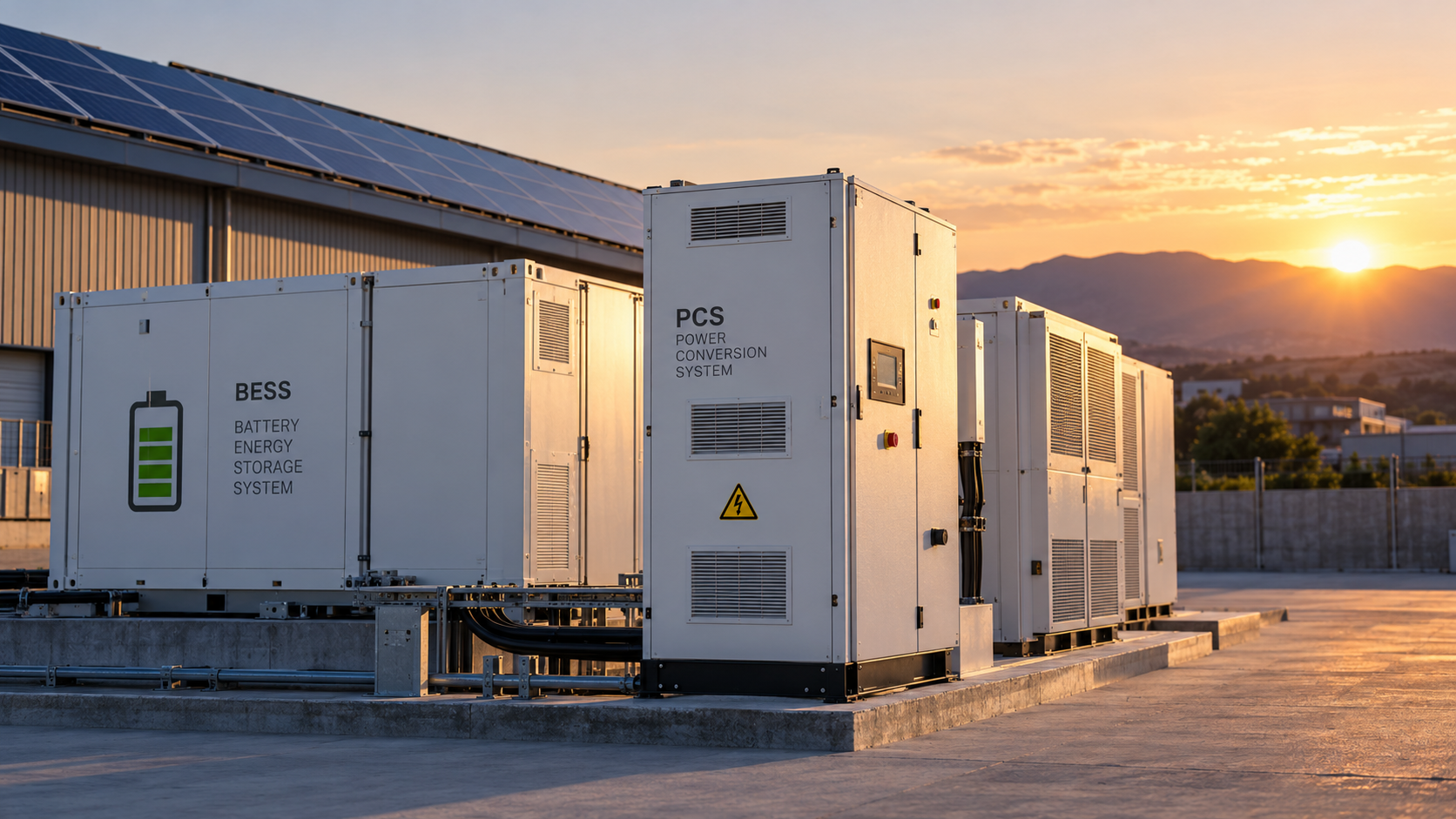
In a Battery Energy Storage System (BESS), it is also essential to manage how energy is converted, distributed and integrated into the electrical installation. This is where the PCS (Power Conversion System) comes into play.
What Is a PCS (Power Conversion System)?
A PCS (Power Conversion System) is a power conversion system that manages the flow of electrical energy between batteries and the grid or an electrical installation.
Batteries store energy as direct current (DC), while most industrial facilities and electrical grids operate on alternating current (AC).
The PCS converts energy in both directions:
-
From alternating current to direct current (AC/DC): allows batteries to be charged using energy from the grid or an AC-connected generation system.
-
From direct current to alternating current (DC/AC): allows the energy stored in the batteries to supply the facility’s electrical loads or be exported to the grid, where permitted.
Unlike a conventional unidirectional inverter, a PCS designed for energy storage supports bidirectional energy flows.
What Is the Role of a PCS in a BESS?
The PCS is a key component in integrating batteries into a company’s energy strategy. Its main functions include:
1. Managing Battery Charging and Discharging
It converts electrical energy so that batteries can be charged and discharged according to the control system’s instructions, while respecting the technical operating limits of the equipment.
2. Integrating Energy Storage with Solar PV Systems
In a facility with solar self-consumption, the PCS enables stored energy to be used when solar PV generation is insufficient or when doing so is more advantageous from an energy and economic perspective.
3. Helping Reduce Peak Electricity Demand
Combined with an Energy Management System (EMS), the PCS enables batteries to discharge during periods of high electricity consumption. This strategy, known as peak shaving, can help reduce peak power demand and optimise electricity costs, depending on each company’s tariff structure and consumption profile.
4. Supporting the Optimisation of Energy Consumption Schedules
The PCS enables load shifting strategies by charging batteries during specific time periods and discharging them at other times. This functionality can provide economic benefits for facilities with significant electricity price differences between tariff periods.
5. Supporting Power Supply Continuity
When the system is designed for islanded operation and includes the necessary switching and protection equipment, the PCS can help provide backup power during grid outages.
It is important to note that not all PCS units support backup operation.
PCS, BMS and EMS: Three Different Systems Working Together
In a BESS installation, it is important to distinguish between three systems that are often confused:
-
PCS (Power Conversion System): converts energy between direct current and alternating current and controls power conversion.
-
BMS (Battery Management System): monitors battery conditions, including voltages, temperatures and operating limits, to protect the batteries and ensure safe operation.
-
EMS (Energy Management System): manages the overall energy strategy, determining when batteries should be charged or discharged based on consumption, generation and other variables.
How to Choose the Right PCS for an Industrial Facility
Not all power conversion systems offer the same capabilities. Therefore, before sizing a PCS, several factors must be analysed:
-
Rated power: determines the maximum power the system can continuously convert under specified conditions.
-
Battery compatibility: voltage and current ranges, as well as the characteristics of the energy storage system, must be verified.
-
Conversion efficiency: energy losses during charging and discharging affect the overall efficiency of the BESS.
-
Compatibility with the electrical installation: connection voltage, protection systems, grid requirements and integration with existing equipment must be considered.
-
Operational capabilities: it is necessary to determine whether the system will be used for self-consumption, peak shaving, load shifting, grid services or backup power supply.
One particularly important aspect is distinguishing between PCS power, expressed in kW, and battery storage capacity, expressed in kWh.
For example, a BESS with a capacity of 400 kWh and a 200 kW PCS could theoretically deliver 200 kW of power for two hours under ideal conditions. In a real installation, this operating time will depend on the available usable energy, losses and operating conditions.
Therefore, correctly sizing the PCS is just as important as determining the battery storage capacity.
Are You Considering a BESS for Your Business?
The PCS is an essential component of any energy storage project, but its performance and contribution depend on the overall system design.
At Solventa6, we help you assess the technical and economic feasibility of integrating battery storage into your business, whether you already have a solar PV installation or are planning a new energy project.
Contact our team and we will analyse which solution best suits your needs.

