
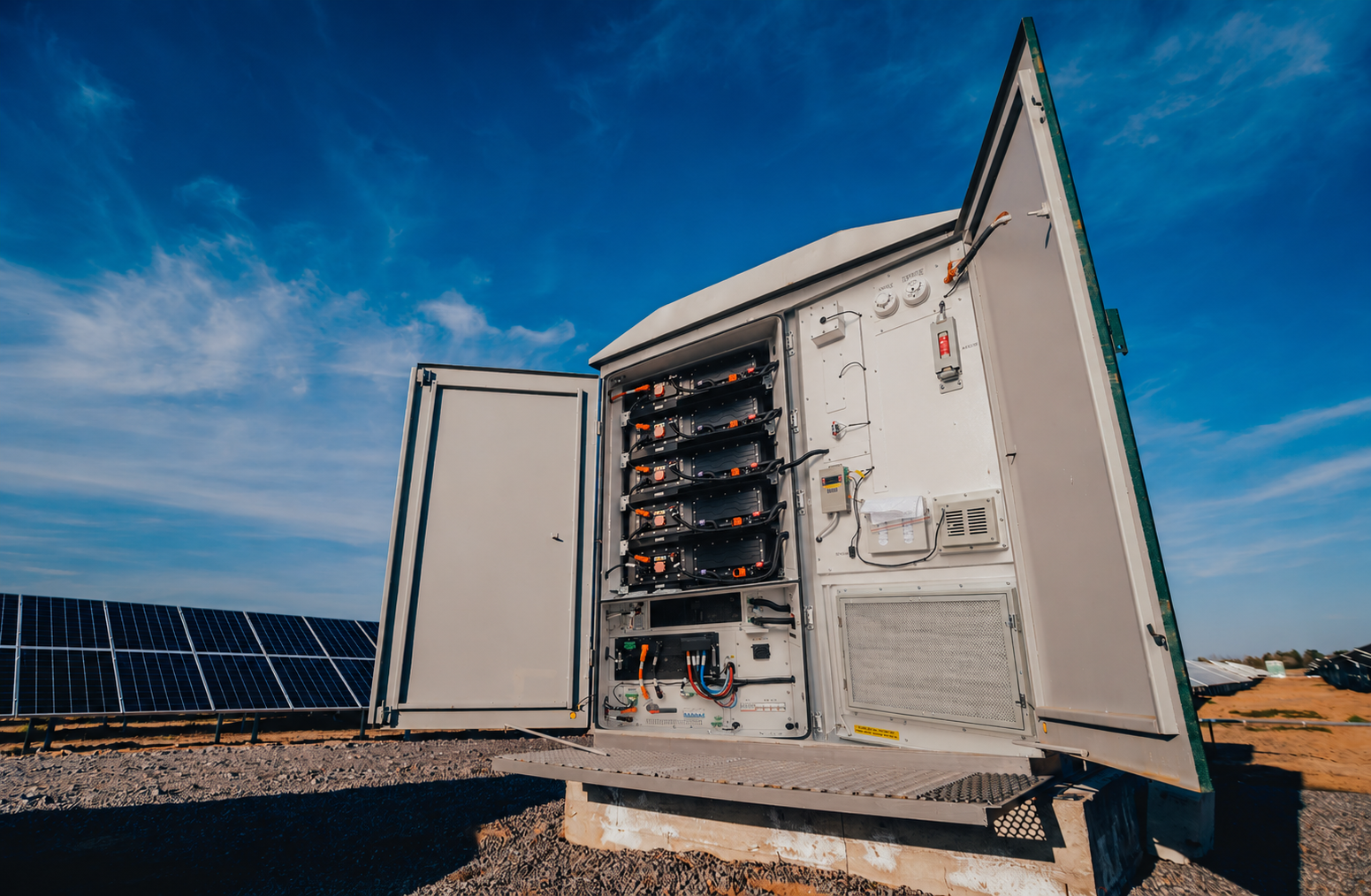
With the arrival of hot weather, many companies and homeowners ask themselves a logical question: are energy storage batteries safe? Can they catch fire? Batteries store energy and, like any technical installation, they require good design, proper installation and adequate maintenance. The difference is that today’s BESS energy storage systems incorporate several levels of safety —electronic, thermal and fire protection— designed to control operation and prevent risks.
Can heat affect a battery?
Yes. Temperature is the factor that most affects the performance and lifespan of a lithium battery. LFP cells, the most common in BESS, operate optimally between 15 and 35 °C. Above this range, chemical degradation accelerates and capacity is lost; far above it, the risk of anomalies increases. That is why thermal management is not an accessory, but part of the system design.
Temperature control systems
Domestic or small-format BESS use air cooling, either through natural convection or with fans. This is a simple solution, suitable for the power and size of these units.
Modern industrial BESS, however, do not simply “ventilate”: they actively manage cell temperature.
They always incorporate a heat pump —air conditioning—, and the final heat dissipation medium can be air —air cooled— or liquid —liquid cooled—:
- Air cooling —HVAC / air conditioning—: climate control of the cabinet or container. It is simpler and more economical, suitable for small and medium-sized systems. It maintains an adequate temperature range, but with larger thermal gradients between cells, around 5–8 °C.
- Liquid cooling: a coolant circuit in indirect contact with the modules. This is the current standard in large-format systems: much more uniform temperature, with gradients of 1–3 °C, longer lifespan, higher energy density and lower auxiliary consumption.
A uniform temperature between cells is essential: thermal differences cause charge imbalances, premature ageing and hot spots. That is why, in industrial projects, liquid cooling has become the reference solution.
The BMS: the brain of the system
The battery management system, or BMS, is much more than a simple controller. In a good BESS, the BMS continuously monitors temperature cell by cell, individually or in pairs, at rack and cabinet level, together with charge, voltage and status parameters for each module.
The effectiveness of this management largely determines product quality. To extend cell lifespan, a good BMS works to keep the temperature always below 45 °C at cell level. If cooling were insufficient, the BMS would progressively reduce the operating regime and, if necessary, stop the plant, long before approaching any risk zone.
Can batteries catch fire?
Zero risk does not exist in any energy installation, but today’s batteries incorporate safety layers that greatly reduce this risk. The critical scenario to avoid is thermal runaway: a chain reaction that can spread from cell to cell. Current BESS combine active detection measures with passive containment measures:
- Early detection (active measure): gas, smoke and temperature sensors integrated with the BMS. Thermal runaway releases detectable gases before flames appear.
- Electrical protection (active measure): prevents short circuits, overloads and overvoltages.
- Compartmentalisation (passive measure): modular design that isolates each pack to limit propagation between modules.
- Ventilation and pressure relief (passive measure): controlled gas evacuation to prevent accumulation and the risk of explosion.
- Extinguishing agents (passive measure): clean agent systems, such as aerosol, Novec/FK-5-1-12 or CO₂, which act without damaging the equipment or leaving residues; in some designs, combined with water to prevent reignition.
All of this is governed by reference regulations and standards (IEC 62619, UL 9540 / UL 9540A, NFPA 855) and by UNEF technical guidelines, which define the requirements for safe design, testing and installation.
The right question
A good product and good engineering are, first and foremost, the best guarantee of safety and performance. In the world of batteries, quality is not a minor detail: there are enormous differences between manufacturers, both in performance and in thermal management and fire protection. Choosing the right product and relying on a competent technical team makes the real difference between a safe installation and a problematic one.
The right question, therefore, is not only whether a battery can catch fire, but whether it has been properly selected, properly sized, properly located and properly supervised. Before installing it, it is necessary to study the consumption of the company or home, the energy generated by the photovoltaic installation, the required storage capacity and the safe location of the system.
A poorly sized battery does not deliver the expected savings. A poorly located battery loses efficiency. And an installation without monitoring creates avoidable incidents. That is why it is so important to rely on a technical team that analyses each case.
A cheap battery almost never really is.
The value of Solventa6
At Solventa6, we study each project to define a safe, efficient and profitable solution. We support the client from the initial analysis through to installation, commissioning and maintenance, integrating the battery into the overall energy installation and ensuring that it operates with technical criteria, safety and performance.
BESS batteries are a tool for moving towards more autonomous, efficient and sustainable energy. But, like any energy solution, they must be properly planned. Contact us about your project and we will advise you on the best solution.

