
Interview with Eduard Andreu Dolcet, Sales and Marketing Director at Solventa6

For years, energy management in many industrial companies has focused on reducing consumption and securing better electricity prices. However, the energy market is changing, and companies must adapt their decisions accordingly.
The growing penetration of renewable energy, price volatility, the electrification of industrial processes and the development of BESS batteries (Battery Energy Storage Systems) are introducing a new variable: flexibility.
We speak with Eduard Andreu Dolcet, Sales and Marketing Director at Solventa6, about how industrial energy management is evolving and the role energy storage systems can play.
How is energy consumption changing in industry?
There is an important shift that many companies have yet to fully embrace: energy is no longer just about how much you consume, but also when you consume it and how much flexibility you have to decide when to use it.
The large-scale integration of renewable energy is making the market much more variable. In Spain, during 2024, there were 784 hours with electricity prices at or below €0/MWh, including 247 hours with negative prices. At other times, however, prices can rise considerably.
Furthermore, since October 1, 2025, the day-ahead electricity market has operated with 15-minute intervals, meaning 96 prices per day.
All this increases the value of an industrial company’s ability to adjust consumption, shift certain processes or store energy.
Therefore, the challenge is no longer simply to pay less per kWh, but to reduce overall energy costs while limiting the company’s exposure to an increasingly volatile variable.
Why might solar self-consumption not be enough for many companies?
Solar photovoltaic energy remains a powerful tool for industry, but we need to change how we assess its value.
Solar installations generate electricity when the sun shines, while factories consume energy when production requires it. These two curves do not always align.
That is why, when analysing a project, the question should not simply be:
“How many kWh will the photovoltaic installation generate?”
We should also ask:
“How many of those kWh will the facility actually consume, when will they be consumed, and what economic value will they provide?”
Imagine an industrial facility with a 1 MWp solar installation generating approximately 1.4 GWh per year. If a significant share of that energy is produced when the facility does not need it, its economic value may decrease.
The problem is not necessarily that the solar installation produces too little energy. The problem is that some of its production may occur at times when it has less value for the company.
This is where concepts such as consumption flexibility and energy storage begin to make sense.
Where do BESS batteries come into play?
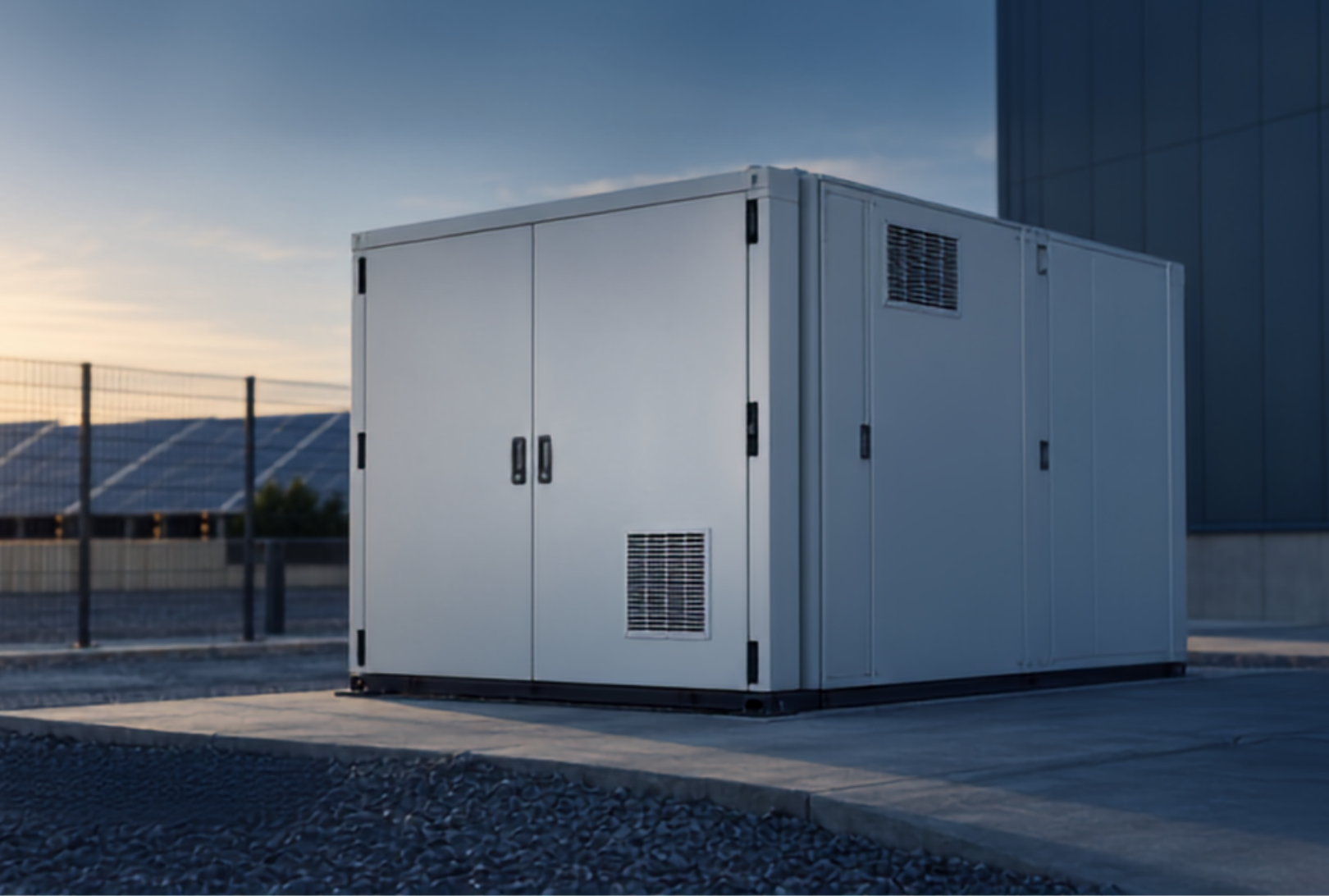
The key shift in mindset is understanding that an industrial battery is not simply a battery: it is an energy flexibility asset.
A BESS can deliver value in several ways.
It can increase solar self-consumption by storing surplus photovoltaic energy for later use.
It can also enable energy arbitrage, charging when electricity costs are lower and discharging when prices are higher.
Another application is peak shaving, which helps manage demand peaks and reduce certain maximum power demands.
Energy storage can also be used for load shifting, moving electricity consumption to different periods and better aligning the facility’s energy demand with production requirements and electricity prices.
In certain configurations, a BESS can also provide backup power or continuity of supply for critical processes during grid disruptions.
A new opportunity is also emerging: capacity services. Spain’s capacity market, established in September 2026, allows energy storage systems that meet the established requirements to participate. For new investments in generation and storage, service provision periods may extend up to 15 years, depending on the technology and the conditions established in each tender.
Combining different sources of value — solar self-consumption, arbitrage, peak shaving, flexibility and capacity services, among others — is known as revenue stacking or value stacking.
Are industrial batteries becoming increasingly competitive?
The technology is evolving rapidly.
According to BloombergNEF, the average price of battery packs for stationary energy storage fell to $70/kWh in 2025, a 45% decrease compared with 2024.
It is important not to confuse this figure with the final cost of an installed industrial BESS. A real project includes many additional components: inverters, EMS, electrical protection systems, fire protection systems, construction works, engineering and integration with existing installations.
However, falling battery costs help explain why more and more companies are exploring energy storage projects.
What mistakes do companies make when considering battery installation?
The main mistake is asking which battery to buy before identifying the economic problem they want to solve.
A 1 MW / 2 MWh battery may be an attractive investment for one industrial facility but make little economic sense for another.
One common mistake is focusing exclusively on self-consumption. If we only calculate how much surplus solar energy can be stored, we may overlook other sources of value.
Another mistake is sizing the battery without analysing the 15-minute electricity consumption profile. A monthly electricity bill does not show what is actually happening inside the facility.
Nor should we focus solely on the BESS purchase price. We must consider degradation, charging and discharging cycles, efficiency, warranties and the cost of the energy that can realistically be shifted throughout the system’s useful life.
Another factor is sometimes overlooked: the electricity supply contract. The battery and the way the company purchases electricity are two parts of the same equation.
Finally, a BESS cannot be viewed simply as hardware. The EMS (Energy Management System), which determines when to charge, when to discharge and which function to prioritise, is essential for capturing the system’s economic value.
Ultimately, we should not buy a battery and then look for ways to use it. We must first identify the sources of value and then size the asset accordingly.
How does Solventa6 analyse a BESS project?
At Solventa6, we try to approach things in the opposite way to what is often done: we analyse the company first and the battery second.
We examine the 15-minute electricity consumption profile, the electricity supply contract, power demand, existing or planned photovoltaic generation and potential future changes at the facility: process electrification, electric vehicles, expansions, new production shifts or increased output.
From there, we develop different scenarios.
We assess how much surplus solar energy can be recovered, which consumption can be shifted, which demand peaks can be reduced and how the results vary under different electricity price scenarios.
This allows us to move from a purely energy-based assessment to an economic analysis of the industrial facility.
And there is an important point here: sometimes, installing a battery is not the best energy investment.
The best solution may be to review contracted power capacity, change the electricity purchasing structure, adjust production schedules, make better use of an existing photovoltaic installation or combine several measures.
That is why the final question should not be:
“Which technology should we install?”
But rather:
“What combination of decisions will allow us to reduce energy costs and improve the facility’s financial performance?”
When managed effectively, energy can become a driver of profitability, flexibility and resilience for industry.

